Tuesday, April 30, 2013

WWII Across the Atlantic Ocean

Reading: http://goo.gl/YcdAe

Essential Question:
1. Who was the Supreme Commander in Europe, and was he successful?
-General Dwight David Elsenhower was the supreme commander in Europe and he was successful because he used his keen mind to have the opponents surrender. 
2. What was the significance of “D-Day?”
-The significant of "D-Day" was that it was the first day of the invasion to liberate Europe (remove Hitler with force) in France. 
3. Was Gen. Patton an effective leader?
-General George Patton was effective because he achieved his goals by liberating Paris (kicking the Nazi's out of France). 
4. Why was the Battle of the Bulge significant?
-The Battle of the Bulge was significant because it was Hitlers desperate last-gasp offensive and lastditch offensive to win the war (Germany attacked the allied forces).

Supreme Commander in Europe, Dwight David Eisenhower. (http://www.whitehouse.gov/sites/default/files/first-family/masthead_image/34de_header_sm.jpg?1250885267)
General George Patton. (https://blogger.googleusercontent.com/img/b/R29vZ2xl/AVvXsEi9vD3b2XKj9DTRHcMM4ysODASZjJz56b8A44W0UuGCV-z962CIBiTLmuGK1kkMxgoCgWEVflF-6L5pTpZzgeyvorT8dkttEgvRnGdIISTD2QulbngOajIgwp0bQRAH4Mww_KYYmwpEhuCJ/s400/General+George+Patton+Famous+Quotes.jpg)

Friday, April 26, 2013

Coping With The War At Home

Reading: http://goo.gl/CxDSv

Essential Questions:
1. What was the OPA, and what was their job?
-The OPA (Office of Price Administration) job was to fight inflation by freezing prices on most goods.
2. What was the purpose of the OSRD?
-The OSRD (Office of Scientific Research and Development) was used to bring scientists into the war; not to fight, but for their brains. 
3.  In what ways did Americans sacrifice during WWII?
-During WWII Americans sacrificed by high costs on merchandise, rationing (sharing equally), allotments (assigned amount), scare (little) of goods (ex/ meat, shoes, sugar, coffee, and gasoline), carpooling (save time, gas, and money), coping with shortage of everything, and hoarding though "black market".  
4.  How similar or different were your sacrifices during the Iraq and Afghanistan wars?
-The difference between WWII and Iraq/Afghanistan is that during WWII we knew what we were fighting for and that people had to sacrifice for their country.

(http://www.genealogytoday.com/guide/ww2/rb_decal.jpg)
(http://osulibrary.oregonstate.edu/specialcollections/omeka/archive/files/937e0d152040f79e89254cb67923a9f7.jpg)

Wednesday, April 24, 2013

U.S. Gets Ready For The Fight


Essential Questions:  
1. Who was Philip Randolph, and why did he and President Roosevelt meet?
-Philip Randolph was a African-American labor leader. He organized a march on Washington to demand colored Americans to be able to have the right to work and fight for their country. Roosevelt and Randolph met because Roosevelt wanted Randolph to call off the march which did happen at the end because they settled under a agreement which allowed colored people to be able to get good jobs and not be discriminated.    
 2. Who were the WAACs, and why were they important to the war effort?
-Women's Auxiliary Army Crops (WAACs) were important to the war effort because they did many essential duties that were needed for men to be able to fight in the war. Some things that women did were become nurses, ambulance drivers, radio operators, etc.
3. How well did African-Americans do during WWII?
-During WWII, African-Americans in the beginning did not do very well because they did not have good jobs because of their race. Although, at the end African-Americans raised because of Philip Randolph help of creating better working conditions/circumstances.     


Philip Randolph. (http://cruiselinehistory.com/wp-content/uploads/2009/01/ransml.jpg)
Women's Army Auxiliary Corps (WAAC). (http://www.ncmuseumofhistory.org/workshops/wwii/waac.poster.jpg)

Monday, April 22, 2013

U.S. Inches Toward WWII


Essential Questions:
1. What was Lend-Lease, and what countries did it benefit?
-Lend-Lease Act was that the President would lend or rest weapons and other supplies to "any country whose denfense was vital to the United States."
2. What did Roosevelt call German u-boats?
-Roosevelt called German U-boats, "Rattlesnakes." 
3. How would you describe Roosevelt’s opinion of war?
-Roosevelt opinion of the war was to have a war because he felt like there could be no peace in a world controlled by dictators. Against the Axis Power: Germany, Italy, and Japan. 

Lend-Lease Act. (http://cf067b.medialib.glogster.com/media/92/929a02b8cf35f2b340f8d91377d390e5eba252f5792d72854a60b0d6155cf6cb/6a00d83451cfe069e20105349fc0c3970c-800wi.jpg)
German Submarine (German U-Boat). (http://www.titanic-whitestarships.com/U-118.jpg)

Thursday, April 18, 2013

World War II Part II

Reading: http://goo.gl/mm8qT

Essential Questions: 
1)List all the countries the Nazi's invaded.
-Austria 
-Czecholovakia
-Poland
-Yugoslavia 
-Bulgaria
-Greece
-Romania
-Hungary
-Lithuania
-Latvia
-Estoni
-Finland
-Norway
-France
-Denmark
-Netherlands (Holland)  
-Belguim
-Soviet Union (Russia)
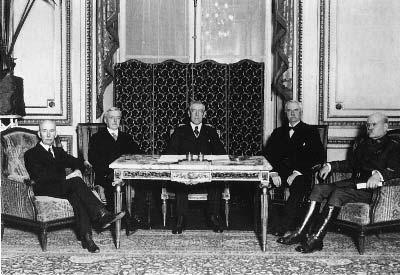
2)What was Munich Agreement, and what was Churchill's opinion of it?
-On September 30, 1928, The Munich Agreement was signed, which turned the Sudetenland over to Germany without a single shot being fired. Winston Churchill thought it was a dishonor because felt that by signing the Munich Agreement, the French and British would adopt a shameful policy of appeasement.
3)What is Blitzkrieg, and what was the purpose?
-Blitzkrieg was a lighting war, which used advances in military technology-to take enemy's by surprise and then quickly crush all oppositions.
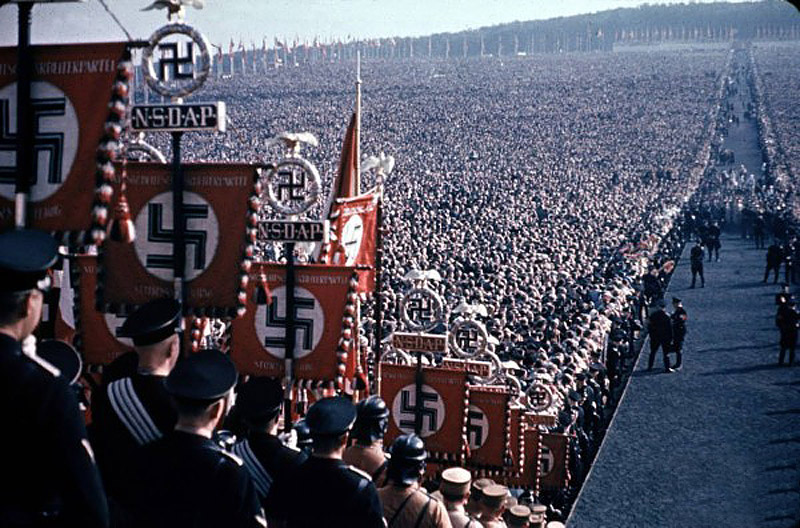
Nazi's. (http://iliketowastemytime.com/sites/default/files/life_nazi_germany_pre_ww2_1.jpg)
Munich Agreement. (https://upload.wikimedia.org/wikipedia/commons/thumb/9/9c/Bundesarchiv_Bild_183-R69173,_M%C3%BCnchener_Abkommen,_Staatschefs.jpg/300px-Bundesarchiv_Bild_183-R69173,_M%C3%BCnchener_Abkommen,_Staatschefs.jpg)

Tuesday, April 16, 2013

World War II Part I


1. What treaty did Hitler hate? Why?
 -Hitler hated the Treaty of Versailles because Germany was blamed for starting WWI and forced to pay war debts.
2. Who became dictators during the 1930’s, and for what country?
 -Joseph Stain- Soviet Union/Russia
-Adolf Hitler- Gemany
-Benito Massolini- Italy 
-Fransico Frano- Spain
-Hideki Tojo- Japan    
3. Explain similarities and differences amongst the dictators.
 -Similarities were that when people interfered with their plans they would "get rid of them." Also, they had powerful public speakers.   
4. What was the U.S. thinking as several wars were breaking out?
-FDR wanted to get into war but the Americans and isolationist newspaper said no because they were suffering though the Great Depression.

Adolf Hitler, Germany. (http://2.bp.blogspot.com/-zBBNGl0BwMY/UMGaGM8_EAI/AAAAAAAAEBQ/eaiCJUsVQIU/s1600/adolf-hitler-.jpg)
Treaty of Versailles. (http://www.redicecreations.com/winterwonderland/versailles.jpg)

Monday, April 15, 2013

World War II Key Terms

1. Allies
-United States, England, and Soviet Union (Russia)
2. Axis
-Germany, Japan, Italy
3. Defense spending
-Amount of money government spends on the military
4. Unemployment rate
-Percent of people unemployed
5. Federal outlay
 -Amount of money  the federal government uses to buy stuff
6. Rattlesnakes of the Atlantic
-(Number 7) 
7. German U-boats
-German submarines
8. Isolationists
-Policy of "mind your business"
9. Appease
-To give in
10. Lend-Lease Act
-Law that allowed President of the United of the States (POTUS) to sell weapons to our friends
11. Office of Price Administration
-U.S. federal agency, established to prevent wartime inflation.
12. Inflation
-When prices for goods/service increases but income remains the same
13. Pres. Franklin D. Roosevelt
-Leading the United States during a time of worldwide economic depression and total war.
14. Pres. Harry S. Truman 
-After Roosevelt died, Truman lead the United States and successfully concluded World War II. Which after marked the start of the Cold War.
15. Phillip Randolph
-Leader of the African-American civil-rights movement, the American labor movement and socialist political parties.
16. Gen. Patton
-General in the United States Army, best known for his command of the Seventh Untied States Army, and later the Third United States Army, in the European Theater of World War II.
17. Gen. MacArthur
-Commanded Allied forces in the Pacific Theater during World War II.
18. Gen. Eisenhower, Supreme Commander of U.S. Forces
-Supreme Commander of the Allied Forces in Europe; he had responsibility for planning and supervising the invasion of North Africa in Operation Torch and the successful invasion of France and Germany from the Western Front
19. Adolph Hitler
-Germany, Nazis
20. Benito Mussolini
-Italy
21. Joseph Stalin
-Soviet Union/Russia22. Winston Churchill
-England/United Kingdom
23. Battle of the Bulge
-The last stand for Germany
24. D-Day
-Offensive by Allies to take over Europe
25. Auschwitz
-Jewish concentration camp
26. Atomic bomb
-Nuclear bomb dropped on Japan to end the war
27. Interment
-Camps on West Coast used to detain Japanese Americans
28. Income tax
-Percent of tax paid on personal income (paycheck)
29. Wage & price controls
-Commonly instituted by governments as a response to inflation, and usually below market level.
30. War bonds
-Debt securities issued by a government for the purpose of financing military operations during times of war.
31. WAACs
-Women's Army Auxiliary Corps (WWAC) was created as an auxiliary unit.
32. WWII Battles of the Pacific
-Naval Aviation News articles to Commemmorate the 50th Anniversary of World War II.
33. GI Bill of Rights
-Servicemen's Readjustment Act, a law that provided a range of benefits for returning World War II veterans. Benefits included low-cost mortgages, low-interest loans to start a business or farm, cash payments of tuition and living expenses to attend college, high school or vocational education, as well as one year of unemployment compensation.
34. Zoot-Suit Riots
-Series of riots in 1943 during World War II that exploded in Los Angles and California between, White sailors and Marines.
Axis & Allies. (http://upload.wikimedia.org/wikipedia/en/5/57/AxisAndAlliesBox.jpg)
World War II (1939-1945). (http://www.daphnelibrary.org/wp-content/uploads/2012/11/World-War-2-Timeline.jpg)